

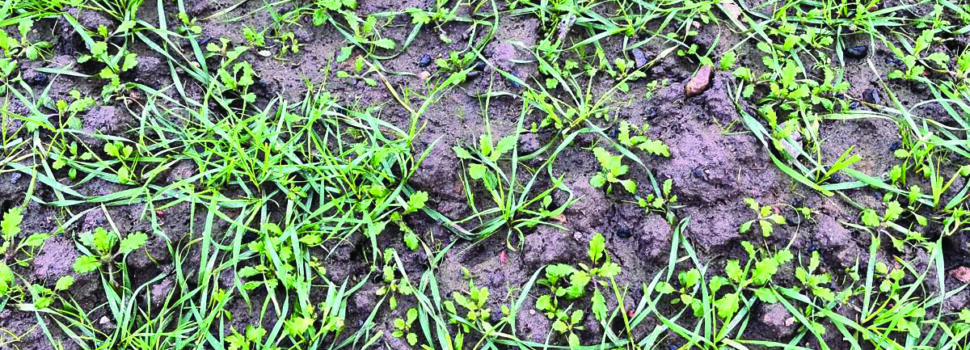


Across the UK, growers are increasingly worried about tougher-to-control broad-leaved weeds, with groundsel a stand-out example.
The arrival of Fundatis, a herbicide approved for use this autumn and effective against a wide range of dicot weeds, including strong activity on groundsel, will therefore be welcomed by many.
Increasing issue
The eastern and central arable areas of England are often associated with an abundance of difficult grassweeds like blackgrass and increasingly Italian ryegrass.
However, management of some broad-leaved species has become a major headache, with groundsel particularly problematic, according to Association of Independent Crop Consultants (AICC) agronomist Martyn Cox.
He says many of his peers are very concerned about how abundant it’s become across rotations in The East, which often contain field veg crops like carrots, parsnips and onions.
Lack of effective chemistry in these crops, particularly post-emergence, has not allowed growers and agronomists to get on top of groundsel populations.
“We have also been applying more and more ALS-inhibitor to control groundsel in cereals and the challenge – particularly if you have a mild winter like the last one – is that you’re seeing it continue to germinate and grow rapidly through until spring,” says Martyn.
Growing seed bank
The weed can complete its lifecycle in just 6-8 weeks, given the right conditions, and Martyn says an increase in maize across the region could also be helping the weed increase its seed bank in the soil.
In a mild and wet winter, on land that is destined maize, groundsel can flower and set seed before there’s an opportunity to spray it off, leading to increased populations.
Martyn notes that there are already cases of herbicide resistant groundsel in the UK, specifically to triazinone herbicides like metribuzin and metamitron, so it’s a species that can evolve readily.
There is a suspicion that the species has already developed resistance to ALS chemistry although this is yet to be officially confirmed.
“In cereals, it makes it particularly important to get an effective, pre-emergence residual herbicide on and then top up a few weeks later.
“If you miss those timings and groundsel is allowed to survive, it will be very difficult to get on top of in the spring,” says Martyn.
Nationwide issue
The toughening of groundsel isn’t confined to Eastern areas. One Cornish grower is seeing much more of the weed across his mixed farm enterprise near Camborne.
Alongside 40ha of grass, Pete Olds grows 160ha of cereals; two-fifths each of wheat and barley, and one fifth oats, which are all used to feed the business’ 17,000 free-range chickens.
Break crops include cabbage and cauliflower, and he’s experimenting with lupins for use in the poultry ration while he lets ground to maize and potato growers when there’s demand.
The presence of open crops such as brassicas, maize and potatoes has facilitated groundsel infestations and he’s looking to bring the new chemistry of Fundatis into his cereal herbicide programmes to tackle the issue.
Following its recent launch Fundatis (beflubutamid + bixlozone) can now be used in winter wheat pre-emergence and up to GS13 and in winter barley pre-emergence only.
Herbicide diversity
Having hosted trials for Fundatis manufacturer FMC, Pete has been encouraged by its activity on broad-leaved weeds like groundsel and sees it as a valuable addition to his weed control armoury.
“We need slightly different chemistry coming in to help combat these problem weeds and any resistance that might be developing. Mixing things up is the name of the game.
“We’ll be trying some at a commercial level this year and I’m particularly keen to see how it goes in barley, where effective chemistry is even more limited than in wheat,” he says.
Kirsty McKenzie, FMC’s commercial technical manager for the west and north, says the focus in these areas has traditionally been on broad-leaved weeds and annual meadowgrass.
In conversations she’s had with growers, groundsel is a weed that has become a particularly emotive subject with the challenging, wet autumns resulting in thinner, uncompetitive plant stands.
Kirsty maintains Fundatis will deliver a timely step forward in groundsel control as some spring-applied SU herbicides are perceived to be offering reduced control.
She notes that this is often down to suboptimal and late application to healthy, strong and waxed-up weeds in the spring, rather than resistance.
“That’s why having something like Fundatis giving high levels of groundsel control in the autumn is so useful. It can significantly reduce the pressure on other herbicides groups, which can only be a positive thing.
“When followed up with a tribenuron-methyl-containing product like Ally Max SX – which is the strongest on groundsel – very good control can be achieved.”
Broad-spectrum label
Kirsty adds that groundsel is just one target on the product’s label listing a plethora of other species susceptible including ivy-leaved speedwell, another weed that has become harder to clean up in recent seasons in certain regions.
Added to the product’s strength on grassweeds this should make it a good fit into most UK farms integrated weed control programme.
“We know it has very good activity on annual meadow grass and are also continuing to assess its activity on other species like brome and wild oats, which are not yet on the label. We know it offers activity, but we need to gain a better understanding about how it performs in commercial trials this year,” notes Kirsty.