

A robust, multi-active T2 fungicide programme could be essential to protect wheat yield potential this season.
Growers should combine single-site and multi-site chemistries for immediate and lasting disease control, suggests Adama UK technical manager David Griffiths. Doing so will protect the flag leaf and leaf two – and encourage grain-fill, he adds.
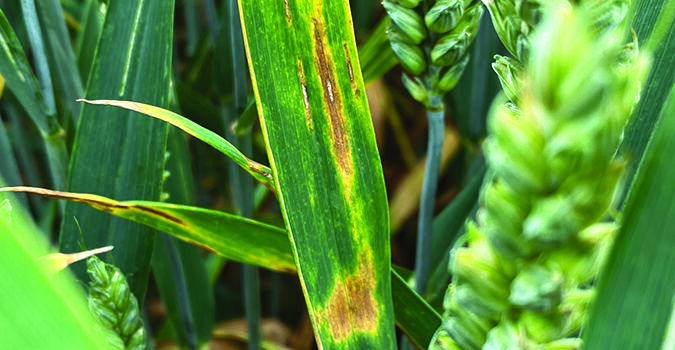
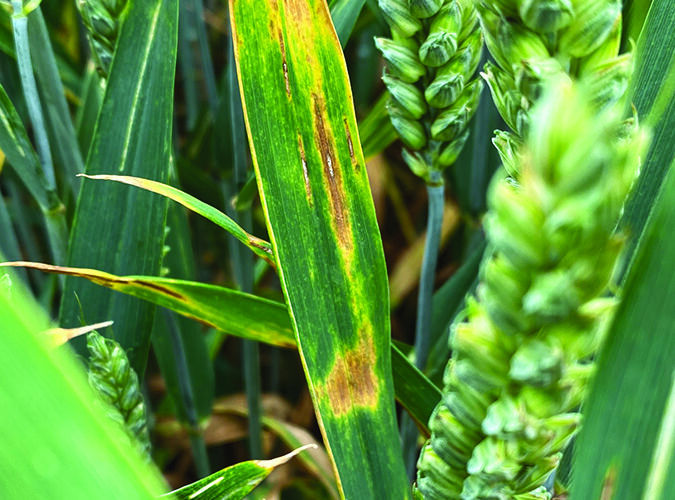
Recent conditions have been relatively favourable for crops, but disease pressure remains in the canopy. Mr Griffiths warns that septoria and rusts are still active.
“Even though weather conditions have been relatively favourable in recent weeks, there is still plenty of both diseases present in crops,” he says.
He adds that spores in the lower canopy can move rapidly during wet weather. Rain splash can transfer infection to upper leaves, threatening yield at a critical stage.
“Any disease spores sitting in the lower canopy could easily be transmitted onto the upper two leaves during heavy rainfall events, so a robust fungicide treatment is a must to keep both leaves as clean and green for as long as possible.”
Relying solely on single-site fungicides increases resistance risk. Azoles and SDHIs provide curative activity, but target only one biochemical pathway. “A T2 treatment based solely on single site actives won’t therefore be enough to keep crops protected as they progress towards maturity,” says Mr Griffiths.
He recommends a multi-site product such as Arizona (folpet) to extend protection and reduce resistance pressure. Seven years of independent trials show that adding Arizona at T2 lifts yield by an average of 0.14t/ha across varying seasons.
Yield benefits
The case for multi-site chemistry strengthens where disease pressure is high. Wet weather has increased septoria risk, says Mr Griffiths. “With this year’s septoria loading so high thanks to the wet winter and spring, the inclusion of Arizona is a no brainer.”
The product can also improve control of yellow and brown rust. Trials suggest yield gains of 0.9t/ha where yellow rust dominates. “To achieve the very best levels of disease control in wheat, Arizona should be used throughout the spring at T1 and T2.”
Even where it was not applied earlier, inclusion at T2 still offers a clear benefit, he adds.