

Livestock farmers facing tight winter forage supplies after the summer drought could extract more value from cover crops by managing them for grazing rather than simply environmental compliance.
Poor grass growth has increased pressure on forage stocks, putting greater emphasis on crops capable of producing usable autumn biomass. But species choice, seed rate and drilling date can determine whether a cover carries livestock or merely keeps soil green.
In August, 71% of England was in drought, with the Environment Agency reporting poor grass growth and increasing pressure on winter livestock forage stocks.
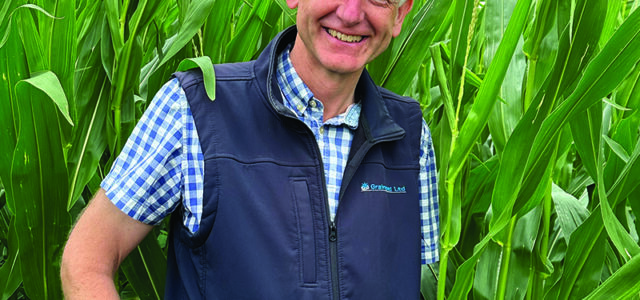
Grainseed general manager and Maize Growers Association council member Neil Groom said growers planning to graze covers should treat them as forage crops from the outset.
“If livestock are going to graze it, biomass and quality have to be an objective from day one,” he said. “A thin crop may cover the soil and meet the environmental objective, but it will not carry stock. You need enough plants, enough bulk and a mixture where every component is doing a job.”
Build bulk
Early establishment remains one of the biggest influences on biomass, although this year growers have also had to contend with limited soil moisture. Cover-crop trials run by Grainseed and the MGA since 2017 have demonstrated the advantage of giving fast-growing species sufficient thermal time before winter.
Trials drilled near Diss, Norfolk, on 15 August saw spring oats and grazing rye produce biomass approaching 10t/ha by the end of November. Both outperformed black oats and winter cereal species.
“For a grazed cover, the cereal component is there to build bulk quickly,” said Mr Groom. “Then you can use brassicas and legumes to add a different architecture and feed profile rather than relying on a token inclusion of several species.”
AHDB guidance emphasises that species within seed mixtures compete with one other. That means proportions and seed rates should reflect the intended outcome rather than simply maximising the number of species included.
Mr Groom said stubble turnips could be used at a lower rate within mixtures, allowing individual roots to bulk rapidly. Oil radish and forage rape provide leaf growth, while vetch introduces a legume.
Spring vetch established by mid-August has produced active nodules by November in trials. Hairy vetch offers greater winter hardiness, although seed costs are higher.
Grazing value
Grainseed’s Graze Green mixture combines spring oats, vetch, oil radish, stubble turnips and forage rape. Mr Groom said it produced the highest biomass in one trial and provided grazing for 150 ewes from Christmas Eve. But not every fast-growing cover species is suited to livestock.
Buckwheat can flower within four weeks when established into adequate moisture, but Mr Groom said it was unsuitable for grazing. Its role is better suited to situations where rapid catch-crop growth is the priority.
Farmers also need to consider what follows the cover. Where maize is planned, previous Grainseed and MGA work found covers should be fully dead before early-April drilling. This reduces the danger of nutrients becoming temporarily unavailable while large quantities of residue decompose.
Brassica termination has another consideration. “Our agronomic target has been to destroy brassicas by the end of February because of the potential of cabbage stem flea beetle larvae being in the stem bases,” said Mr Groom.
Destroying covers before larvae leave plants to pupate can reduce the risk of producing adult beetles that could threaten subsequent oilseed rape crops.
Payment rules
SFI requirements add another layer to the calculation, particularly where growers want both grazing and scheme income.
Under SFI26, CSAM2 pays £129/ha annually for a multi-species winter cover crop and permits grazing. However, the cover must remain well established through winter. Destruction for an early-sown spring crop is limited to six weeks before establishment.
SOH3 pays £163/ha for a summer-sown multi-species cover but is not designed for winter grazing. Grazing is permitted only when destroying the crop, with destruction limited to two weeks before establishment of the following main crop.
Those restrictions mean farmers need to match the payment option with their intended grazing and cropping dates before establishment.
For livestock businesses, the calculation should extend beyond the SFI payment to include the value of grazing produced, soil protection and benefits to the following crop.
“The SFI payment can strengthen the economics, but it should not be the specification,” Mr Groom said. “If the cover is going to earn its keep, those three things have to work together.”