

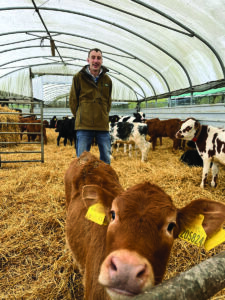
 Fourth-generation farmer Matt Price uses a forage-first approach and careful grazing management to help meet the challenge of rising input costs in Shropshire. Mr Price manages manages a mixed livestock operation with his father and sister at Bockleton Court, Ludlow. He runs 600 Mules and Clun Forest ewes, and 750 cattle – a mix of Aberdeen-Angus, Limousin and British Blues.
Returning to the farm ten years ago after graduating from Harper Adams University, Mr Price combines his experience with the family’s farming heritage to shape a system rooted in forage utilisation to control costs.
Mr Price says: “The aim is always to get as much performance off grass as we can. If we can keep stock doing well without pushing a lot of concentrate, that’s where the margin is.”
The Prices farm around 240 hectares of owned and rented land plus additional grass keeps. They also grow 32 hectares of winter barley and oats as a break crop and for straw but buy in grain for feed.
Herbal leys
Most of the grassland is in Sustainable Farming Incentive herbal ley options, though Mr Price is measured about their value.
“Herbal leys look good, and we drench less frequently by having them, but I’m not convinced they beat a decent ryegrass and clover mix in terms of yield and palatability,” he says.
Mr Price sees the main advantage as financial, particularly on marginal ground or awkward fields previously used for cereals.
The Prices are strengthening hedge boundaries where needed and persisting with the herbal leys, but Mr Price says uncertainty around SFI poses challenges.
“It makes it harder to run a business when the goalposts keep moving,” he adds.
Despite last summer’s record-breaking temperatures, autumn was largely favourable for grass growth in the Ludlow area, with good levels of dry matter and strong regrowth holding on late into the season and early winter, before easing with the shorter days.
“Last summer’s grass covers were lighter than expected due to the dry spell, so careful grazing management has been essential. We’re mostly on medium soils here, which carry moisture quite well,” says Mr Price. “Covers weren’t quite where we wanted by mid-summer, but rotational grazing helped us keep things moving to recover the ground.”
Matt prefers to use larger grazing mobs to create rest periods that allow swards to rebound. “It costs good money to grow those first few centimetres of grass. But leave it a week or so and you suddenly have double the growth.”
Silage quality has proved variable, with yields around 20% down on average. Late-cut October silage was wetter at around 10-12% dry matter, says Mr Price. It has been fed to cattle outside on kale to maintain intakes during the winter, while drier first and second-cut material is being used for housed stock and those closer to sale.
Richard Wynn, head of technical at Crystalyx, says: “With many farmers opening the silage clamp earlier than planned, they should focus on optimising available feed and forage.
“When silage stocks are tight and quality may be low, making every mouthful count is the key to success. It’s important to balance energy and protein levels while feeding cereals and add structural fibre, like chopped straw or hay to help balance the rumen and avoid triggering sub-acute rumen acidosis.”
Dr Wynn adds: “When forage quality is down, don’t wait long to supplement and consider the most practical way to get energy in. Acting early can improve forage digestibility and energy intake to maintain performance.”
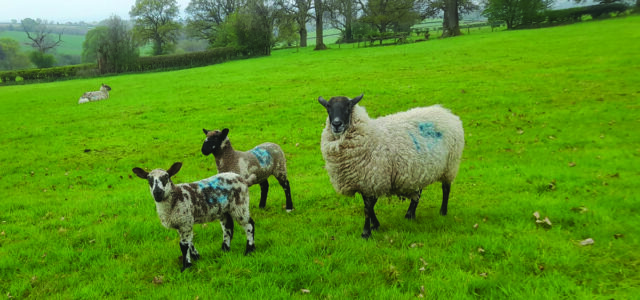
The farm lambs in three batches, 1 March, 15 March, and 1 April, with most lambing indoors before turn-out. Last spring, warm weather meant Mr Price could turn sheep and lambs out as soon as they were able; a marked contrast to the previous year, when wet ground forced prolonged housing and increased labour. Keeping an eye on body condition is key. Ewes are split into lean, mid and fit groups so each receives the grazing or supplementation they require.”
Sheep management
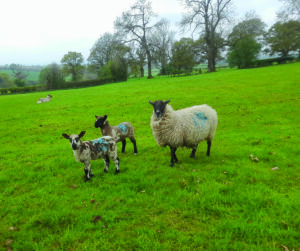 “If they’re in the right shape, scanning percentages are higher and when it gets to lambing, things tend to go smoother and milk quality is better.”
Scanning rates have risen by around 15% over the last five years, something Matt attributes to better mineral management, toxoplasmosis vaccination and flock monitoring.
While the Prices are forage-led, supplementation plays an important role particularly where grass quality dips to support macro nutrition and to ensure micro nutrition is covered.
One of the biggest challenges at Bockleton Court is mineral deficiency. Soil and blood testing has shown low levels of selenium, cobalt and copper which fluctuates with the seasons.
“The year before last, because the grass was so wet, we really saw the copper deficiency show up,” says Matt. “Sheep didn’t look as well and weren’t doing as much off the grass.”
This prompted the family to add in a high energy supplement, to support stronger ewe performance.
Mr Price uses a molasses-based high-energy mineral lick for hoggs, store lambs on stubbles, and ewes needing pre-tupping support. Post-lambing, he uses high-calcium licks to support milk production and promote lamb growth.
“Taking control of your nutrition, focusing on body condition and making the most of the forage in front of you will give you the best chance of a decent year.”
Matt’s top tips
• Match feed to need, avoid overfeeding singles, prioritise lean stock, and use forage strategically
• Use feed licks, mineral blocks and boluses where needed, especially for labour savings and to cover soil deficiencies
• Test, don’t guess with regular forage and blood testing to reveal hidden nutrient gaps
• Keep an open mind and adjust management to the conditions in front of you, not the calendar