

New technology is helping to optimise fertiliser applications as growers strive to offset rising nitrogen prices caused by turmoil in the Middle East.
A 34% spike in the price of granular fertiliser has put a serious dent in arable budgets – with the Agriculture and Horticulture Development Board citing war in the Gulf as the main cause.
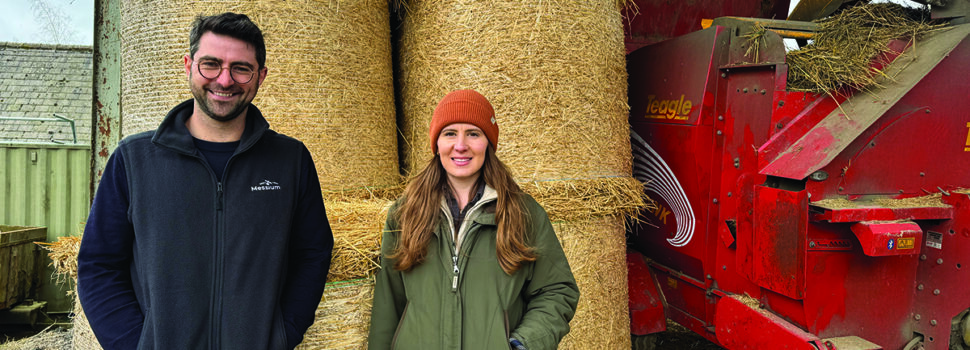
Like many other growers, agronomist and farmer Louise Penn is finding new ways to reduce fertiliser costs. Hyperspectral satellite imaging is already making more efficient use of what is an increasingly expensive input, she says.
“Nitrogen is probably one of the most expensive inputs when it comes to growing a crop of wheat, barley, or oilseed rape,” explains Ms Penn, who farms at Manor Farm, on the Castle Ashby Estate, in Northamptonshire.
Performance
Targeting applications makes sense agronomically and environmentally – as well as from a farm business perspective – so long as it doesn’t disproportionately affect crop yields and quality.
In a bid to ensure she is getting value for money, Ms Penn has teamed up with crop intelligence company Messium, through Agri-TechE’s Ambassador Programme, to explore whether hyperspectral technology could be the solution.
Some technologies use a Normalised Difference Vegetation Index (NDVI) to estimate crop greenness and biomass as a proxy for nitrogen health. But Messium is different, says Spencer Terry, the company’s commercial director.
Messium uses hyperspectral satellite imagery to directly detect nitrogen levels in each plant at a cellular level – assessing the nitrogen balance in the crop and measuring the uptake, explains Mr Terry.
Reducing usage
The process captures around 400 wavelengths and evaluates how they reflect off crops, focusing on those responsive to nitrogen, he adds. This allows farmers to apply nitrogen more precisely, reducing overall usage.
“We can tell whether a crop is over-fertilised, under-fertilised, or well-fertilised throughout the growing season,” says Mr Spencer.
“Previous generations of satellites were looking at vegetation and using that greenness to approximate the nutrient health and status of the crop. We’re measuring the nutrient status of the crop straight away, directly by looking at the nitrogen balance”.
Ms Penn has already set up the platform and uploaded all relevant field data, with unique field names, yield targets and soil types. Images from Messium will help support precision targeting in future applications to reduce nitrogen use.
“The image can also detect which parts of the field have greater deficiencies than others. Then, we will use this data as input to assist with the next fertiliser application, aiming to correct those deficiencies and restore the crop to its optimal level. This allows us to apply more fertiliser to the areas that are more deficient and less to those that are not.”