




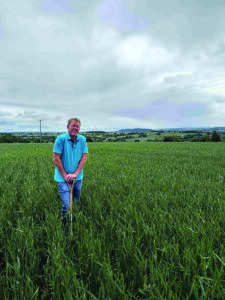
 An award-winning grower says reconsidering his crop nutrition choices has helped improve his farm business – and soil health.
Herefordshire farmer John Joseph, of Trecorras Farm, near Ross-on-Wye, says better nutrient management on his 100ha holding was key to being crowned Farm Carbon Toolkit Soil Farmer of the Year in 2025.
Soils are mainly sandy loam. The farm, which was purchased in 2013 specialises in seed production and wheat for the Wildfarmed brand. But Mr Joseph says it failed to see proportional returns during the early days after he took it on.
“Our margins were tightening, our yields were very stagnant, if not declining, and our soils were unhealthy. We were at risk of increasing inputs and getting less return, which was putting the business in financial uncertainty.”
Soil biology
Realisation that his current fertiliser application was not delivering, and was detrimental to the soil, further encouraged Mr Joseph to explore regenerative farming practices aimed at repairing the soil biology and improving efficiency.
“We realised that the soil-applied fertilisers we’d been using were very inefficient and acidic – reducing the health of the soils,” he says. “I didn’t want to admit it, but the cost-to-benefit ratio was clear.”
Mr Joseph found a solution in reducing fertiliser application rates and using more targeted, foliar techniques. “We focused on feeding to the crop need, rather than covering it in a blanket fertiliser application,” he explains. “We started to include multi-minerals and foliar treatments in the programme to spoon-feed the crops, ensuring they had access to a range of nutrients to grow robustly and withstand disease and pest threats.”
Investment
Although the upfront cost of targeted fertiliser application can be higher, Mr Joseph says he quickly recognised that the long-term benefits were going to far outweigh the initial investment.
“The efficiency of foliar feeding is much higher, with some products boasting 90-98% efficiency, compared to soil-applied or granular fertilisers, which are often only 60% efficient at best,” he explains.
“Essentially, these products were much more cost-effective as I was getting the full value of the nutrients rather than wasting almost half of it – and you can’t put the health of your soil into pounds.
“Paying more for sustainable products contributes to the growth of a nutritionally balanced plant, which can fight threats naturally, meaning it’s more cost-effective in the long run.”
For many growers, the shift towards precision fertilisation requires more than just technical adjustments – it calls for a change in mindset. Mr Joseph admits this was a challenge, but changes in the fertiliser market helped.
“Moving away from more traditional farming methods was a challenge to begin with, particularly when results weren’t immediate,” he says.
“It went against everything I was taught at agricultural college and had practiced, but increased product costs and learning what blanket fertilisers were doing to the soils definitely helped to shift my mindset.
“I soon learnt that if a plant was nutritionally healthy, and not a wash with nitrogen, it could better withstand disease and pest threats,” Mr Joseph adds.
Growers considering a more targeted approach should consider incorporating it into the latter stages of their plant growth because doing so can have the biggest impact.
“Just do it – you’ll have a much healthier plant and soil as a result,” he says. “The more precise we can be, the more efficient and sustainable farming will become.”
A new solution
Only about 60% of soil-applied nitrogen is taken up by crops. The remaining 40% is lost to the wider environment. For farms already facing tight margins and high input costs, that has a direct impact on the bottom line.
The scale of that loss is prompting calls for a shift away from blanket fertiliser strategies towards more targeted approach. And it’s clear that uniform soil application and standard rates fail to reflect field variability or crop demand.
The industry must rethink established practice, says Andrew Sincock, managing director at Agro-Vital. Each unit of nutrient that fails to be used by the crop represents a direct cost to the farmer.
“It’s time for the industry to challenge the norm – not only to optimise crop performance, but to cut avoidable losses and demonstrate responsible nutrient management.”
Targeted Application
Agronomy is moving towards closer alignment between nutrient supply and crop need, argues Mr Sincock. “The agronomy sector is progressing towards more targeted fertiliser application to match supply more closely with crop demand.”
Agro-Vital has developed a crop nutrition system that uses soil or sap analysis from individual farms to create tailored fertiliser programmes. The aim is to replace one-size-fits-all field treatment with adaptable formulations based on crop condition.
“Nutrition needs to be done differently,” says Mr Sincock. “Triplex is designed to deliver nutrients precisely where and when they’re needed, offering a practical, rapid and crucially, sustainable solution for farmers.”
The system analyses farm data and generates bespoke foliar blends. Mr Sincock says speed is central to its value. It can create a tailored fertiliser programme in as little as 48 hours, allowing farmers to act quickly and efficiently.
For growers, the business case rests on measurable gains in efficiency and output. That’s why bespoke foliar fertiliser products are delivered on farm in IBC containers, ready to be applied.
“The speed of implementation is crucial, especially during key planting or growing periods, when timely nutrient applications can make a significant difference to crop performance,” says Mr Sincock.
The technology was introduced at the LAMMA Show 2026 and received the IAgrE Ivel Award for overall innovation. Early work in the Netherlands has been followed by initial UK trials ahead of a full operational season in 2026.
The question now is whether improved nutrient use efficiency can translate into stronger margins while meeting environmental scrutiny. If targeted nutrition cuts waste and lifts performance, more growers will make the switch.