

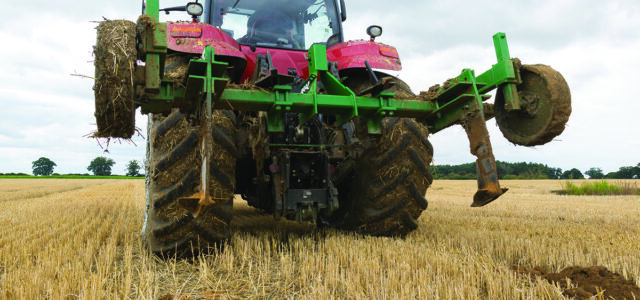
Growers could avoid unnecessary cultivation costs by checking soil structure and nutrient reserves this autumn – rather than following a standard post-harvest crop-establishment programme.
An unusually early harvest has provided more time for field assessments, while prolonged drought means soil conditions may differ significantly from a normal season, says BASIS-qualified agronomist Will Oliver.
Residual nitrogen could also be higher in some fields because dry weather reduced leaching and crops matured early, explained Mr Oliver, who also farms in his own right on the Leicestershire-Warwickshire border.
 Dig first
Growers should resist assuming that hard ground requires remedial cultivation, he added. “Instead of focusing on what you’ve done historically, or what others are doing, let your soil dictate what action you take.”
Mr Oliver recommends using a spade to assess structure in individual fields before bringing out cultivation equipment. “If soils were in good condition before, there’s no reason to assume they won’t recover once moisture returns,” he said.
Cracks and channels created during the drought could improve water infiltration when rainfall returns, he added. Light discing could provide a lower-cost alternative where intervention is required.
After inspecting his own soils, Mr Oliver sees little justification for subsoiling. “Deep cultivation in very dry soils will increase metal wear and machinery damage for little agronomic pay off.”
Nutrient reserves
Growers should take a similarly evidence-led approach to autumn nutrition, particularly for oilseed rape, said Sam Leadbeater, sales manager for crop nutrition specialists OCI UK and Ireland.
“Good nutrition at establishment is key for OSR, particularly ensuring phosphate, potash and sulphur availability.”
Soil and tissue testing can identify deficiencies rather than growers applying nutrients routinely. Residual soil nitrogen could be particularly difficult to predict this autumn.
“With little rainfall, there’s been less leaching or run-off, while crops also matured much earlier, cutting nitrogen uptake short,” said Mr Leadbeater. But reserves will vary because some growers reduced nitrogen applications earlier in the season. “That’s why soil testing will be particularly important this year.”
Target inputs
Where autumn nitrogen is justified, Mr Leadbeater recommends considering sulphur alongside it to improve nitrogen use efficiency. Sulphur helps plants convert nitrogen into proteins by supporting the formation of amino acids and enzymes.
More broadly, the wider message is to use the extended post-harvest period to establish what individual fields require before spending money.
“This year, soil condition and nutrient demand will vary field to field,” said Mr Leadbeater. “Use the extra time to test, assess and base decisions on what each field actually needs.”
With margins under pressure, avoiding an unnecessary cultivation pass or fertiliser application could prove as valuable as choosing the right input, he concluded.