

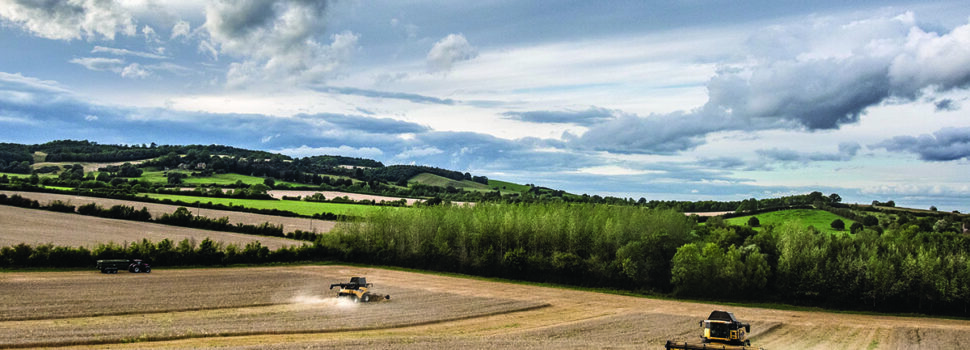
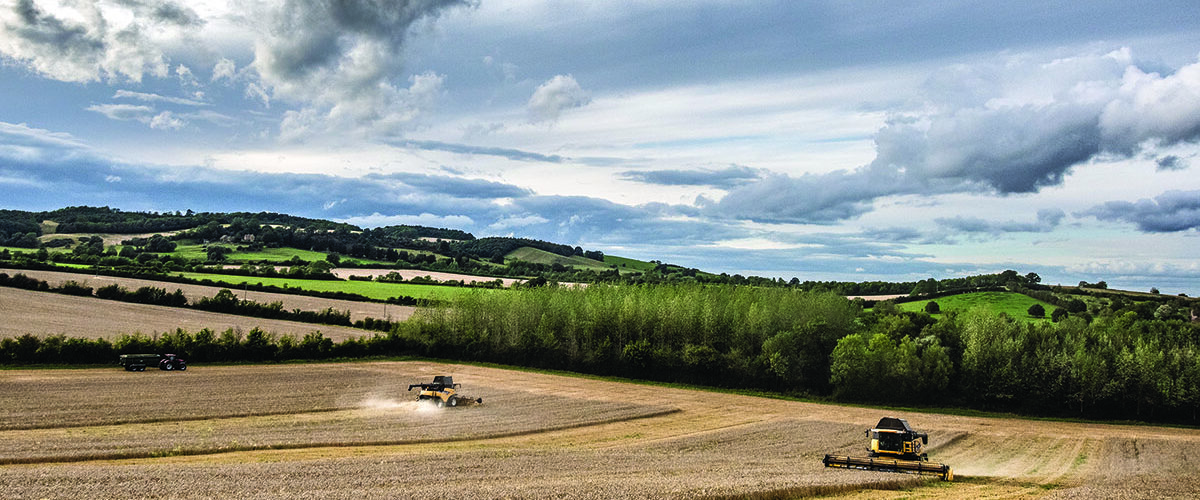
 When Warwickshire arable farmer Hugh Forsyth returned to the family business in 2005, he stepped into a legacy of farming and set about building a future-proof business.
Before taking the reins, Mr Forsyth studied at the Royal Agricultural College, Cirencester. He also completed two-and-a-half years with Velcourt on their assistant manager scheme.
“You’d work eight days a week, 365 days a year, but it was an excellent grounding, especially for starting on the business at home with my old man,” he recalls.
Partnership
Mr Forsyth’s father and uncle had farmed in partnership at Tubbs End farm in Butlers Marston, near Kineton, for four decades across 3,200ha. “They did an amazing job; no phones, no communication just maps, lots of kit and lots of people,” says Hugh.
Upon his return, the family were farming just 160ha. Two decades later, Tubbs End Farm has two strands to the business, farming its own land and running a contracting and farm administration business covering 1,600 hectares in total.
“We’ve built the business up from renting and contract farm agreements to where we are now – farming around 1600ha, with 1200ha of combinable crops and another 400ha under options like wild bird mixes, pollen nectar plots and herbal leys – crops that don’t need harvesting.
A 13,000-tonne grain store, providing cleaning and colour-sorting capability supports the operation. The business employs six people, including Mr Forsyth’s father, who remains involved at 76.
A fifth-generation farmer, Mr Forsyth hopes to pass the baton to his two daughters, should they choose to go into farming.
With this long-term view, he aims to build an economically and environmentally sustainable business.
Shifting practices
Initially rooted in an intensive system, Mr Forsyth shifted two thirds of his operation to regenerative and low-input practices in recent years, driven by rising input costs, economic uncertainty and a desire to restore his soils.
“Five or six years ago we were
fully intensive, but I wanted to get off that conveyor belt of inputs and ag-chem,” he says.
“When you know your fertiliser and spray dates a year ahead it can get pretty mundane, so I wanted to try something new, seek out different markets.
“There’s nothing wrong with an intensive system. A third of our business is still in milling wheat, growing intensively and doing well, but we needed something less exposed to political and weather shocks and that gives back to the soil.”
The move proved timely: “When Covid and the Ukraine war hit, fertiliser prices trebled overnight. It just didn’t feel sustainable,” says Mr Forsyth.
“In a high-input system, if you get it right the reward is high, but if you get it wrong it’s completely the other way. Now, about two-thirds of the farm is no or very low input and our focus is on margin and resilience, rather than chasing yield.”
Restoring life to the soil
A key part of the shift has been growing cereals with an understory of white leaf clover and companion crops. “This fixes nitrogen, builds soil fertility and structure, and keeps living roots in the ground, boosting organic matter and encouraging beneficial insects,” says Mr Forsyth.
Herbal leys are harvested and composted on-farm, producing a biologically active soil conditioner. “It takes about three or four months but produces an excellent conditioner, which we inject with live bacteria and fungi and put straight back on the fields.”
The team monitors soil organic matter, carbon, worm counts, beetles and red-listed birds, comparing data from regenerative areas against a control field.
“We’ve not used an insecticide for eight or nine years. You don’t really need a test to see the difference; there’s more life in the fields,” he says.
Premium markets
Mr Forsyth has tapped into demand from premium markets. He grows ancient grains, heritage rye, wheat and barley, for Fielden Whisky, serving as the company’s head offFarming. He supplies Wildfarmed with low-input cereals, grown among flowering strips and legumes, using no herbicides to meet their regenerative standards.
“If you’re on grade-1 soils you’d be looking at veg and salads and can chase yield all day, but on our heavy Warwickshire clay this is a better, lower-risk route,” he says.
“It’s about protecting the business, having several outlets – not reliance on a single market. Working with premium producers means we can grow nutrient-rich grain in a way that restores soil and get paid properly for it. People are willing to pay more for high-quality, local produce farmed sustainably.
“That support is what makes this system stack up. If you can add environmental schemes, like SFI, on top it becomes a good margin.”
Consistency in contracting
Mr Forsyth applies the same principles across the farms he contracts for. “We try to model the same approach across the board, so all the different landowners are on the same page, going in the same direction,” he explains.
He sees growing appetite in regenerative farming among neighbours. “There’s a real interest, but farmers need security to make those changes. Stacking SFI actions, using green lending and adding a premium market on top removes a lot of risk. Without that support it’s easy to just keep doing what you’ve always done.”
The work on soil health, companion cropping, water management and reduced inputs at Tubbs End Farm aligns with regional findings in a recent sector-wide report from Lloyds Banking Group, which identified rainwater harvesting, soil and sediment retention, and integrated pest management as key opportunities for the Midlands.
The Farming with Nature report is the largest study of its kind. It mapped 5.1 million hectares, almost one third of UK farmland, to highlight where practices can deliver the greatest financial and environmental returns and where targeted support can help farms transition.”
Recommendations
At Tubbs End, many of the report’s recommendations are already in motion. The farm harvests rainwater, plans to reinstate a borehole to reduce mains reliance and is exploring solar and battery storage to improve energy self-sufficiency.
Reduced pesticide use, minimum tillage and an emphasis on soil improvement mirror the report’s guidance on boosting soil health and protecting watercourses.
For Mr Forsyth, the shift a long-term investment in the land and the business. With his daughters in mind, he wants a farm capable of withstanding whatever comes next.
“Whatever is thrown at us – weather, markets or politics, we’ve got to be able to ride the storms and come out the other side,” he says. “This system gives us the best chance of doing that while investing in our soil.”