


-
Herbicide use declines 90%
-
Weed control saves £160/ha
-
Fusarium test highlights risk
Onion growers are cutting herbicide use by about 90% and saving up to £160/ha on weed control by adopting camera-guided spot spraying technology.
The savings come as rising production costs and dwindling herbicide options put margins under pressure. Growers are also turning to new soil testing technology to reduce losses from Fusarium Basal Rot (FBR), which is estimated to have cost 10-20% of last year’s crop in store.
Both technologies were highlighted by Vegetable Consultancy Services (VCS) at its technical and variety open day at RG Abrey Farms, near Thetford. The event brought together growers, breeders, machinery manufacturers and crop input suppliers after a difficult season dominated by drought and irrigation pressures. 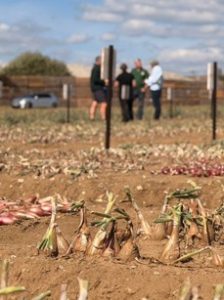
Targeted control
The Ecorobotix spot sprayer uses cameras to identify weeds before applying herbicide precisely to individual targets. Ernest Doe distributes the machines in the UK, with VCS providing agronomic support to growers adopting the technology.
Demand has increased sharply. VCS agronomist and farm support consultant Angus Hill expects 40 machines to be working on British farms by the end of the year. Most are used primarily in onions, although growers can deploy them in other root crops when capacity permits.
“The lack of herbicides is driving the adoption, but it is a cost saving exercise as well. Growing costs are rising sharply, so growers are trying to seize any opportunity to cut costs. There is around a 90% reduction in herbicide use. For one grower, even factoring in the increased cost of application, I calculated they were saving £150-£160/ha on weed control.”
“We are getting complete weed death using the Ecorobotix sprayer, rather than just constantly knocking them back without killing them. With a spot sprayer, we are also not affecting the crop – there’s no phytotoxicity,” says Mr Hill. He estimates the reduction in crop damage could deliver a 10% yield gain compared with a conventional herbicide programme. Growers generally still apply a conventional pre-emergence treatment before using the spot sprayer for post-emergence applications. Mr Hill recommends conventional selective herbicide mixtures at higher doses rather than total herbicides such as glyphosate. That reduces the risk of crop damage if the machine inadvertently sprays part of an onion plant.
A good operator can cover about 25ha a day, he estimates. 
Disease warning
Growers are also being encouraged to use a new soil test to assess FBR risk before committing land to onions. VCS research consultant agronomist James Fortune estimates FBR caused losses of 10-20% of last year’s crop during storage. Control is difficult and uncertainty remains over how long the pathogen survives in soil.
The new quantitative PCR test detects levels of Fusarium oxysporum cepae (FOC), the pathogen responsible for FBR. It was developed by the University of Warwick’s Crop Centre and ADAS through the UK Research and Innovation-funded FUSED project, led by B-Hive Innovations. Results use a traffic-light system to give growers a practical assessment of the threat.
“The result is reported using a traffic light system,” says ADAS technical director Faye Ritchie. “Green means little or no FOC was detected, so the risk is low. Amber means FOC was detected at a level that may affect less than 10% of the crop, and red means FOC was detected at a level that may affect 10% or more of the crop.”
“Avoiding planting in soil infected with FOC is currently the only effective management strategy to reduce the risk of crop loss caused by FBR. This test, developed through scientific and industry collaboration with University of Warwick, allows growers to assess risk before planting.” she says.
Dr Fortune recommends testing every field intended for onions, including land with no previous history of the crop. “Last year, we had some growers that purposely didn’t plant in some fields based on the evidence from the test,” he says. 
Variety choice
The open day also demonstrated how breeders are responding to production pressures. More than 60 varieties were entered in VCS trials this year, three times the number entered in 2025.
The plots included drilled onions, shallots, eschalions and onion sets. Growing varieties from competing seed houses under the same field conditions allows growers to compare developmental and near-market material directly.
VCS has conducted onion variety trials for 20 years – but has expanded the open day into a larg er industry event in recent seasons.
“This season has been tough for growers. The drought has put pressure on irrigation and water availability. We are also now concerned about Fusarium because of the stress crops have been under,” says Dr Fortune.